
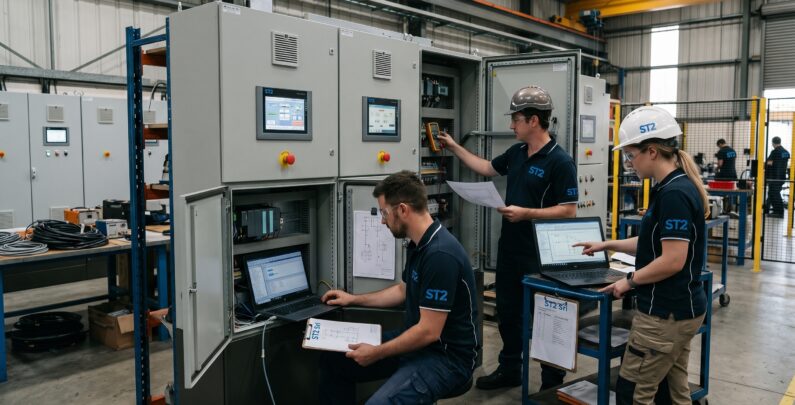
FAT and SAT testing for industrial: plantsPlant Commissioning and Start-up
In electrical and instrumentation (E&I) engineering, the journey from theoretical design to the industrial operation of a facility is marked by critical milestones and rigorous quality checks. Among these, the testing phases serve as the ultimate proving ground for ensuring operational reliability, intrinsic safety, and full regulatory compliance, The FAT and SAT testing for industrial.
In particular, the methodical and punctual execution of FAT and SAT tests for industrial plants serves as the fundamental pillar upon which the success of any industrial project is built—whether in the Oil & Gas sector, advanced manufacturing, the energy industry, or complex chemical processes.
Discover our services, click her
FAT and SAT testing for industrial plants: On-Site Verification at the Manufacturer’s Facility
The Factory Acceptance Test (FAT) is conducted directly at the supplier’s or system integrator’s facility before the equipment is shipped to the site. This preliminary phase makes it possible to verify that electrical panels, PLC- or DCS-based automation systems, and skid packages comply with the project’s technical specifications and applicable international standards.
Conducting a thorough FAT for industrial plant FAT and SAT testing means:
- Validating software logic: Stress-testing hardware and software interfaces through I/O signal simulations, ensuring that each component responds in accordance with the cause-and-effect matrix established during the detailed engineering phase.
- Detecting early anomalies: Promptly resolving wiring faults or bugs in the control logic within a safe and controlled environment.
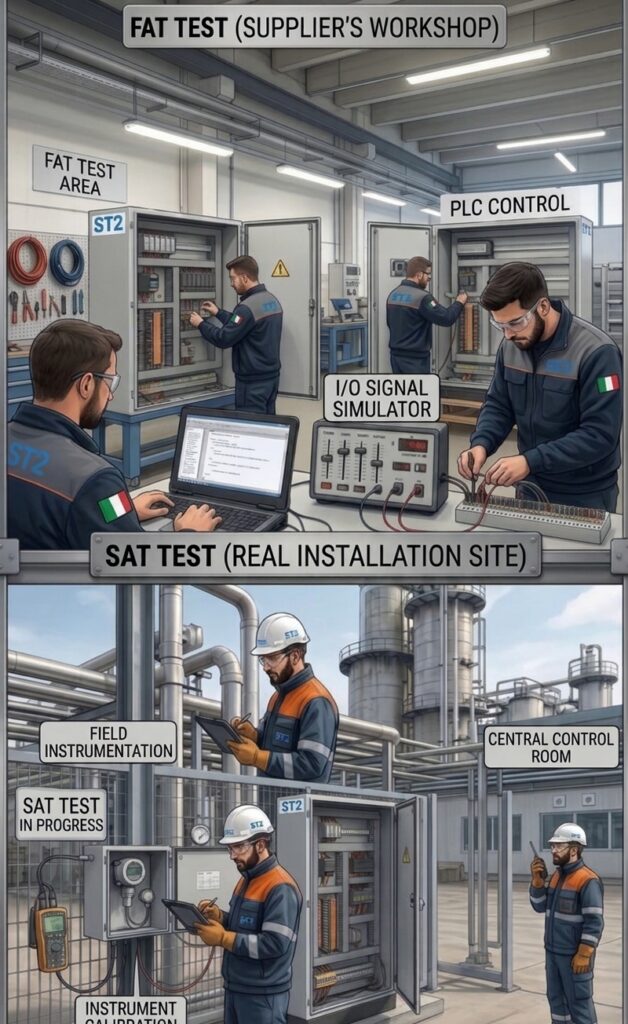
- Reducing construction site costs: Avoiding expensive field modifications and critical delays to the installation schedule.
FAT and SAT Testing for Industrial Automation: The Site Acceptance Test (SAT) – Integration into the Actual Environment
However, passing the factory acceptance test does not complete all the verifications required for commissioning. Once the components have been transported, anchored, and positioned in their final locations at the installation site, the Site Acceptance Test (SAT) comes into play.
This second phase validates the system’s integration into its actual operational environment. During the SAT, engineers verify:
- Component integrity: The absence of damage incurred during transport and the correctness of field connections.
- Calibration and communication: The proper calibration of measuring instruments and seamless communication between peripheral devices, industrial networks, and the central control room.
- Response under operating conditions: Simulation of actual operating conditions to verify that the response times of shut-off valves and the handling of alarms are perfectly synchronized.
Vulnerability Management in the industrial ecosystem
Managing vulnerabilities in an industrial environment requires a different approach compared to IT. It is not always possible to apply immediate patches to PLCs without risking critical disruptions. The appropriate strategy involves using passive monitoring systems that detect anomalies in network traffic without sending control packets, ensuring constant visibility without interfering with real-time processes.
Loop Check and Total Cost of Ownership Optimization
The testing process typically concludes with loop checks, verifying the continuity and accuracy of the signal from each field instrument all the way to the supervisory system.
Relying on specialized expertise for the execution of FAT (Factory Acceptance Testing) and SAT (Site Acceptance Testing) for industrial plants drastically reduces commissioning time, minimizes unplanned downtime during start-up, and safeguards the client’s overall investment. The adoption of standardized testing protocols—complete with detailed reporting and traceability matrices—therefore represents a strategic investment for optimizing the Total Cost of Ownership (TCO) and ensuring high, long-lasting performance.
Support for Testing Your Industrial Systems?
Contact the ST2 Srl team today to schedule testing, inspection, and commissioning activities for your E&I systems.

Recent Comments